Related Colours#
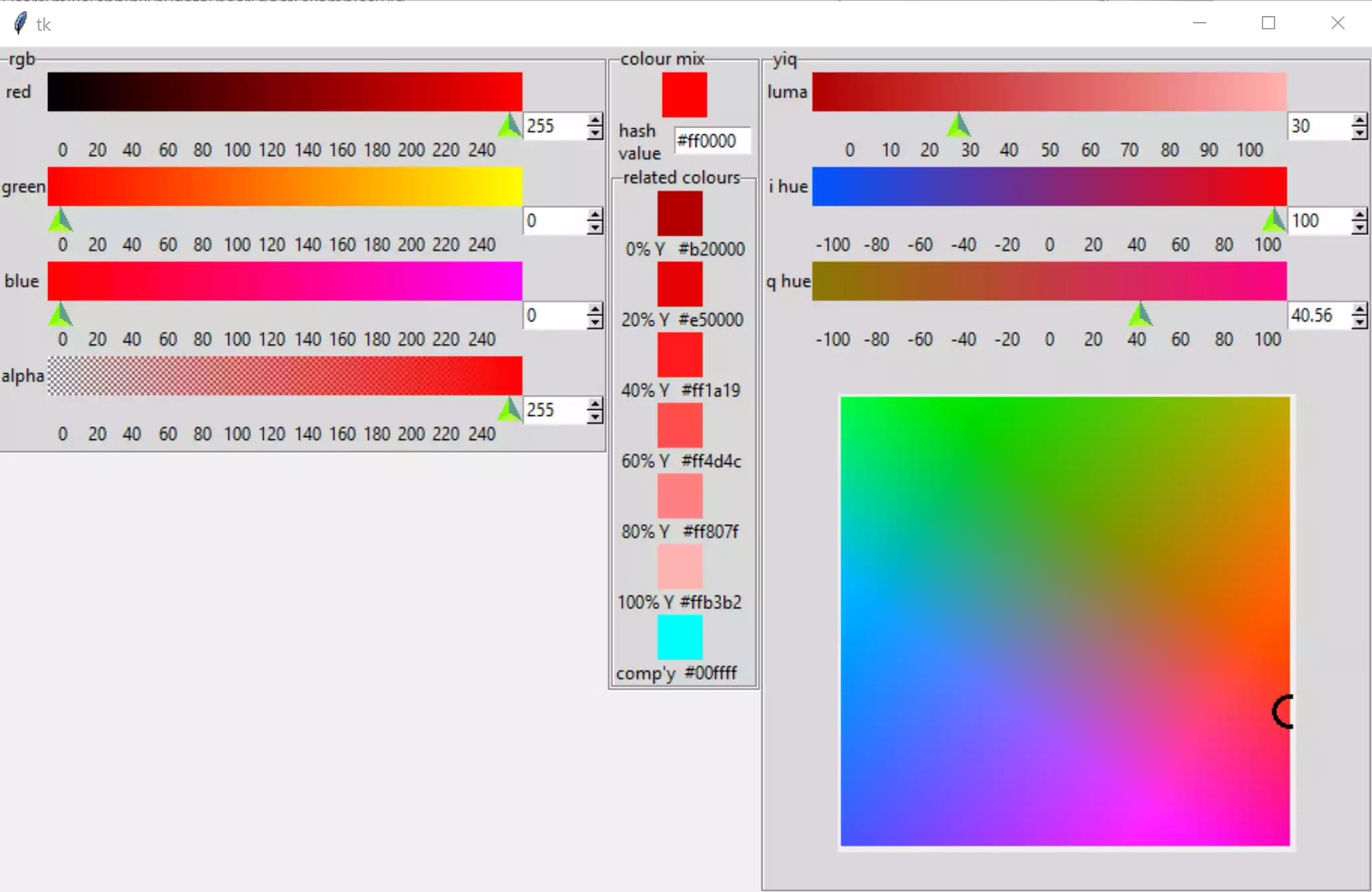
Combined RGB and YIQ with Related Colours#
No matter where we are on the spectrum it is easy to calculate related colours using YIQ. Just keep the hue constant that is the I and Q components, then adjust the luma Y and read off the related colour. The complementary colour is not much more complicated, multiply the I and Q values by -1 and take away the luma from 100.
Something similar can be done in HSV. Related colours have the same hue, so adjusting saturation and value gave the related colours. Often it is obvious, especially when dealing with fully saturated and 100% value, in these cases saturation starts at white and finishes with our colour mix while value starts at black and finishes with our colour mix.
However try with brown and it is a different story. With a hash value of #7f3f3f, hue sits at 0 and both saturation and value are both 50. Are related colours found by changing saturation or value, or both? With YIQ there is no such ambiguity. Keeping I and Q constant (equivalent to hue constant in HSV) change the luma and the related colours do not change.
Resizing#
Resize along similar lines to RGB and HSV, but now use
a single resize function, where the name of the Canvas is included in
our bind call. Special provision is made using the partial method fron
the package functools. Depending on the Canvas name so the appropriate
gradient is redrawn with a new width. The actual values of the colour
components need to be found before the gradients are drawn. Just as before
update the default Canvas width, otherwise once the resizing is
complete any cursor movement could result in wrongly sized gradients.
Show/Hide Code 05relatedyiqlist.py
""" Construction four gradients in rgba three gradients in yiq using PPM image
spinbox validation, working with modified Scale and colour space in yiq
using loop and lists to display similar widgets
"""
from tkinter import Tk, Canvas, IntVar, Frame, PhotoImage, StringVar
from tkinter.ttk import LabelFrame, Scale, Style, Entry, Spinbox, Label
from PIL import Image, ImageDraw, ImageTk
from functools import partial
from yiqTools import rgb2hash, circle, draw_gradient, draw_agradient, \
vdraw_gradient, hash2rgb, yiq_okay, is_okay, sb_okay, rgb_to_yiq, yiq_to_rgb
class TtkScale(Scale):
"""Class to draw themed Scale widget
Parameters
----------
parent : str
parent widget
from_ : int
start of scale
to : int
end of scale
length : int
length in pixels
orient : str
orientation
variable : str
tk variable
digits : int
length variable when converted to string
tickinterval : float or int
how many digits show up in tick interval
sliderlength : int
what it says
command : str
procedure called when slider moves
"""
def __init__(self, parent, length, from_=0, to=255, orient='horizontal',
variable=0, digits=None, tickinterval=None, sliderlength=16,
command=None):
self.from_ = from_
self.to = to
self.variable = variable
super().__init__(parent, length=length + sliderlength, orient=orient,
variable=variable, from_=from_, to=to, command=command)
self.digits = digits
self.length = length
self.build(parent, from_, to, sliderlength, tickinterval, length)
def build(self, parent, from_, to, sliderlength, tickinterval, length):
"""Create ttk Scale ticks.
Parameters
----------
parent : str
parent widget
from_ : int
start of scale
to : int
end of scale
length : int
length in pixels
tickinterval : float or int
"""
sc_range = to - from_
if tickinterval:
for i in range(from_, to + 2, tickinterval):
item = Label(parent, text=i)
j = (i if from_ > 0 else i - from_)
item.place(in_=self, bordermode='outside',
relx=sliderlength / length / 2 +
j / sc_range * (1 - sliderlength / length),
rely=1, anchor='n')
class RgbYiqSelect:
"""Class to construct yiq, rgba gradients, final colour
and yiq colour space
Parameters
----------
fr : str
parent widget
"""
def __init__(self, fr0, enlargement):
self.fr0 = fr0
self.e = enlargement
self.yvar = StringVar()
self.ivar = StringVar()
self.qvar = StringVar()
self.rvar = IntVar()
self.gvar = IntVar()
self.bvar = IntVar()
self.avar = IntVar()
self.evar = StringVar()
self.scale_l = 300*self.e
self.sliderlength = 16*self.e
self.canvas_w = self.scale_l - self.sliderlength
self.canvas_h = 26*self.e
self.canvas_b = 30*self.e
self.space = 301*self.e
self.ring_radius = 10*self.e
self.ring_width = 3*self.e
self.build()
self.yvar.set(30)
self.ivar.set(100)
self.qvar.set(40.56)
self.rvar.set(255)
self.gvar.set(0)
self.bvar.set(0)
self.avar.set(255)
self.evar.set('#ff0000')
def yhandle(self, *evt):
"""Command callback for y.
Parameters
----------
evt : str
command handle
"""
y = float(self.yvar.get())
i = float(self.ivar.get())
q = float(self.qvar.get())
from_colour = yiq_to_rgb(*(0, i, q))
to_colour = yiq_to_rgb(*(100, i, q))
draw_gradient(self.cans[0], from_colour, to_colour,
width=self.canvas_w, height=self.canvas_h)
from_colour = yiq_to_rgb(*(y, -100, q))
to_colour = yiq_to_rgb(*(y, 100, q))
draw_gradient(self.cans[1], from_colour, to_colour,
width=self.canvas_w, height=self.canvas_h)
from_colour = yiq_to_rgb(*(y, i, -100))
to_colour = yiq_to_rgb(*(y, i, 100))
draw_gradient(self.cans[2], from_colour, to_colour,
width=self.canvas_w, height=self.canvas_h)
self.overlord(yiq=(y, i, q))
def iqhandle(self, *evt):
"""Command callback for i.
Parameters
----------
evt : str
command handle
"""
y = float(self.yvar.get())
i = float(self.ivar.get())
q = float(self.qvar.get())
from_colour = yiq_to_rgb(*(0, i, q))
to_colour = yiq_to_rgb(*(100, i, q))
draw_gradient(self.cans[0], from_colour, to_colour,
width=self.canvas_w, height=self.canvas_h)
from_colour = yiq_to_rgb(*(y, -100, q))
to_colour = yiq_to_rgb(*(y, 100, q))
draw_gradient(self.cans[1], from_colour, to_colour,
width=self.canvas_w, height=self.canvas_h)
from_colour = yiq_to_rgb(*(y, i, -100))
to_colour = yiq_to_rgb(*(y, i, 100))
draw_gradient(self.cans[2], from_colour, to_colour,
width=self.canvas_w, height=self.canvas_h)
X = i * 3 / 2 + 150*self.e
Y = q * 3 / 2 + 150*self.e
ring_radius = self.ring_radius
for s in self.canYiq.find_withtag("ring"):
self.canYiq.coords(
s,
X - ring_radius,
Y - ring_radius,
X + ring_radius,
Y + ring_radius)
self.overlord(yiq=(y, i, q))
def door_bell(self, ring):
"""Bind callback from cursor.
Parameters
----------
ring : tuple of int
y, i, q values
"""
# calls from bind
i, q = ring
y = float(self.yvar.get())
from_colour = yiq_to_rgb(*(0, i, q))
to_colour = yiq_to_rgb(*(100, i, q))
draw_gradient(self.cans[0], from_colour, to_colour,
width=self.canvas_w, height=self.canvas_h)
from_colour = yiq_to_rgb(*(y, 0, q))
to_colour = yiq_to_rgb(*(y, 100, q))
draw_gradient(self.cans[1], from_colour, to_colour,
width=self.canvas_w, height=self.canvas_h)
from_colour = yiq_to_rgb(*(y, i, 0))
to_colour = yiq_to_rgb(*(y, i, 100))
draw_gradient(self.cans[2], from_colour, to_colour,
width=self.canvas_w, height=self.canvas_h)
self.overlord(yiq=(y, i, q))
def related(self, y, i, q):
lumas = [0, 20, 40, 60, 80, 100]
for ix, luma in enumerate(lumas):
relcol = rgb2hash(*yiq_to_rgb(luma, i, q))
self.rccans[ix]['background'] = relcol
self.rccans[ix].background = relcol
self.rcls[ix]['text'] = relcol
comp_col = rgb2hash(*yiq_to_rgb(100-y, -i, -q))
self.cccan['background'] = comp_col
self.cccan.background = comp_col
self.ccl['text'] = comp_col
def rgbhandle(self, evt=None):
"""command callback for red, green, blue"""
red = self.rvar.get()
self.rvar.set(red)
green = self.gvar.get()
self.gvar.set(green)
blue = self.bvar.get()
self.bvar.set(blue)
alpha = self.avar.get()
self.avar.set(alpha)
draw_gradient(self.rgbcans[0], (0, green, blue), (255, green, blue),
width=self.canvas_w, height=self.canvas_h)
draw_gradient(self.rgbcans[1], (red, 0, blue), (red, 255, blue),
width=self.canvas_w, height=self.canvas_h)
draw_gradient(self.rgbcans[2], (red, green, 0), (red, green, 255),
width=self.canvas_w, height=self.canvas_h)
draw_agradient(self.rgbcans[3], (127, 127, 127), (red, green, blue),
self.e, width=self.canvas_w, height=self.canvas_h)
vdraw_gradient(self.cmcan, (red, green, blue), self.e, alpha=alpha,
width=self.canvas_b, height=self.canvas_b)
self.evar.set(rgb2hash(red, green, blue))
self.overlord(rgb=(red, green, blue))
def ahandle(self, *evt):
"""Command callback for alpha,
Parameters
----------
evt : str
command handle
"""
red = self.rvar.get()
green = self.gvar.get()
blue = self.bvar.get()
alpha = self.avar.get()
self.avar.set(alpha)
vdraw_gradient(self.cmcan, (red, green, blue), self.e, alpha=alpha,
width=self.canvas_b, height=self.canvas_b)
def overlord(self, rgb=None, hasho=None, yiq=None):
"""Supervisory procedure to control calls from handles
Parameters
----------
rgb : tuple of integers
rgb
yiq : tuple of integers
yiq
Returns
-------
draws gradients and sets other colour system
"""
if rgb:
red, green, blue = rgb[0], rgb[1], rgb[2]
y, i, q = rgb_to_yiq(red, green, blue)
from_colour = yiq_to_rgb(*(0, i, q))
to_colour = yiq_to_rgb(*(100, i, q))
draw_gradient(
self.cans[0],
from_colour,
to_colour,
width=self.canvas_w, height=self.canvas_h)
from_colour = yiq_to_rgb(*(y, -100, q))
to_colour = yiq_to_rgb(*(y, 100, q))
draw_gradient(
self.cans[1],
from_colour,
to_colour,
width=self.canvas_w, height=self.canvas_h)
from_colour = yiq_to_rgb(*(y, i, -100))
to_colour = yiq_to_rgb(*(y, i, 100))
draw_gradient(
self.cans[2],
from_colour,
to_colour,
width=self.canvas_w, height=self.canvas_h)
self.yvar.set(y)
self.ivar.set(i)
self.qvar.set(q)
X = i * 3 / 2 + 150*self.e
Y = q * 3 / 2 + 150*self.e
ring_radius = self.ring_radius
for s in self.canYiq.find_withtag("ring"):
self.canYiq.coords(
s,
X - ring_radius,
Y - ring_radius,
X + ring_radius,
Y + ring_radius)
self.related(y, i, q)
if yiq:
y, i, q = yiq[0], yiq[1], yiq[2]
red, green, blue = yiq_to_rgb(y, i, q)
draw_agradient(self.rgbcans[3], (127, 127, 127),
(red, green, blue), self.e,
width=self.canvas_w, height=self.canvas_h)
alpha = self.avar.get()
vdraw_gradient(self.cmcan, (red, green, blue), self.e, alpha=alpha,
width=self.canvas_b, height=self.canvas_b)
draw_gradient(self.rgbcans[0], (0, green, blue), (255, green, blue),
width=self.canvas_w, height=self.canvas_h)
draw_gradient(self.rgbcans[1], (red, 0, blue), (red, 255, blue),
width=self.canvas_w, height=self.canvas_h)
draw_gradient(self.rgbcans[2], (red, green, 0), (red, green, 255),
width=self.canvas_w, height=self.canvas_h)
self.evar.set(rgb2hash(red, green, blue))
self.rvar.set(red)
self.gvar.set(green)
self.bvar.set(blue)
self.related(y, i, q)
def resize(self, event, can=''):
W = event.width
self.canvas_w = W
red = self.rvar.get()
green = self.gvar.get()
blue = self.bvar.get()
if can == self.rgbcans[3]:
draw_agradient(self.rgbcans[3], (127, 127, 127),
(red, green, blue), self.e, width=W, height=self.canvas_h)
if can == self.rgbcans[0]:
draw_gradient(self.rgbcans[0], (0, green, blue),
(255, green, blue), width=W, height=self.canvas_h)
if can == self.rgbcans[1]:
draw_gradient(self.rgbcans[1], (red, 0, blue),
(red, 255, blue), width=W, height=self.canvas_h)
if can == self.rgbcans[2]:
draw_gradient(self.rgbcans[2], (red, green, 0),
(red, green, 255), width=W, height=self.canvas_h)
def resize_yiq(self, event, can=''):
W = event.width
self.canvas_w = W
y = float(self.yvar.get())
i = float(self.ivar.get())
q = float(self.qvar.get())
if can == self.cans[0]:
from_colour = yiq_to_rgb(*(0, i, q))
to_colour = yiq_to_rgb(*(100, i, q))
draw_gradient(self.cans[0], from_colour, to_colour,
width=W, height=self.canvas_h)
if can == self.cans[1]:
from_colour = yiq_to_rgb(*(y, -100, q))
to_colour = yiq_to_rgb(*(y, 100, q))
draw_gradient(self.cans[1], from_colour, to_colour,
width=W, height=self.canvas_h)
if can == self.cans[2]:
from_colour = yiq_to_rgb(*(y, i, -100))
to_colour = yiq_to_rgb(*(y, i, 100))
draw_gradient(self.cans[2], from_colour, to_colour,
width=W, height=self.canvas_h)
def build(self):
"""widget construction"""
lf1 = LabelFrame(self.fr0, text='rgb')
lf1.grid(column=0, row=0, sticky='new')
lf1.columnconfigure(1, weight=1)
vcmdsb = root.register(sb_okay)
self.rgbcans = []
rgbsboxes = []
rgbcomps = ['r', 'g', 'b', 'a']
rgbnames = ['red ', 'green', 'blue ', 'alpha']
rgbvars = [self.rvar, self.gvar, self.bvar, self.avar]
rgbhandles = [self.rgbhandle, self.rgbhandle, self.rgbhandle, self.ahandle]
binds = [self.checksb, self.checksb, self.checksb, self.checksba]
for ix, comp in enumerate(rgbcomps):
Label(lf1, text=rgbnames[ix]).grid(row=3*ix, column=0)
Label(lf1).grid(row=2+3*ix, column=2)
self.rgbcans.append(Canvas(lf1, height=self.canvas_h, width=self.canvas_w,
bd=0, highlightthickness=0))
self.rgbcans[ix].grid(row=3*ix, column=1, sticky='ew', padx=self.sliderlength//2)
self.rgbcans[ix].bind("<Configure>", partial(self.resize,
can = self.rgbcans[ix]))
TtkScale(lf1, self.scale_l, from_=0, to=255, variable=rgbvars[ix],
orient='horizontal', command=rgbhandles[ix],
tickinterval=20).grid(row=1+3*ix, column=1, sticky='new')
rgbsboxes.append(Spinbox(lf1, from_=0, to=255, textvariable=rgbvars[ix], validate='key',
validatecommand=(vcmdsb, '%d', '%P', '%S', 0, 255), command=rgbhandles[ix], width=5))
rgbsboxes[ix].grid(row=1+3*ix, column=2, sticky='nw')
rgbsboxes[ix].bind('<KeyRelease>', binds[ix])
lf3 = LabelFrame(self.fr0, text='colour mix')
lf3.grid(column=1, row=0, sticky='nw')
self.cmcan = cmcan = Canvas(lf3, bd=0,
highlightthickness=0, width=self.canvas_b,
height=self.canvas_b)
cmcan.grid(column=0, row=0, sticky='n', columnspan=2)
cmcan.grid_propagate(0)
vdraw_gradient(self.cmcan, (255, 0, 0), self.e, alpha=255,
width=self.canvas_b, height=self.canvas_b)
cml = Label(lf3, text='hash\nvalue')
cml.grid(column=0, row=1)
vcmd = root.register(is_okay)
self.en = en = Entry(lf3, width=8, validate='key',
validatecommand=(vcmd, '%i', '%P', '%S'), textvariable=self.evar)
en.grid(column=1, row=1)
en.bind('<KeyRelease>', self.checkhash)
lf5 = LabelFrame(lf3, text='related colours') # style='Width.Tlabelframe'
lf5.grid(column=0, row=2, sticky='nw', columnspan=2)
self.rcls = []
self.rccans = []
relateds = [0, 20, 40, 60, 80, 100]
rtexts = ['0% Y', '20% Y', '40% Y', '60% Y', '80% Y', '100% Y']
for ix, rel in enumerate(relateds):
Label(lf5, text=rtexts[ix]).grid(row=1+2*ix, column=0, sticky='n')
self.rcls.append(Label(lf5))
self.rcls[ix].grid(row=1+2*ix, column=1, sticky='n')
self.rccans.append(Canvas(lf5, bd=0,
highlightthickness=0,width=self.canvas_b,
height=self.canvas_b))
self.rccans[ix].grid(row=2*ix, column=0, sticky='n', columnspan=2)
self.cccan = Canvas(lf5, width=self.canvas_b, height=self.canvas_b, bd=0,
highlightthickness=0)
self.cccan.grid(column=0, row=12, sticky='n', columnspan=2)
self.ccla = Label(lf5, text = "comp'y")
self.ccla.grid(column=0, row=13, sticky='n')
self.ccl = Label(lf5, text = "")
self.ccl.grid(column=1, row=13, sticky='n')
draw_gradient(self.rgbcans[0], (0, 0, 0), (255, 0, 0),
width=self.canvas_w, height=self.canvas_h)
draw_gradient(self.rgbcans[1], (255, 0, 0), (255, 255, 0),
width=self.canvas_w, height=self.canvas_h)
draw_gradient(self.rgbcans[2], (255, 0, 0), (255, 0, 255),
width=self.canvas_w, height=self.canvas_h)
draw_agradient(self.rgbcans[3], (127, 127, 127), (255, 0, 0),
self.e, width=self.canvas_w, height=self.canvas_h)
lf4 = LabelFrame(self.fr0, text='yiq')
lf4.grid(column=2, row=0, sticky='ew')
lf4.columnconfigure(1, weight=1)
vcmdyiq = root.register(yiq_okay)
self.cans = []
sboxes = []
comps = ['y', 'i', 'q']
names = ['luma', 'i hue', 'q hue']
tkvars = [self.yvar, self.ivar, self.qvar]
handles = [self.yhandle, self.iqhandle, self.iqhandle]
froms = [0, -100, -100]
ticks = [10, 20, 20]
for ix, comp in enumerate(comps):
Label(lf4, text=names[ix]).grid(row=3*ix, column=0)
Label(lf4).grid(row=2+3*ix, column=2)
self.cans.append(Canvas(lf4, width=self.canvas_w, height=self.canvas_h,
bd=0, highlightthickness=0))
self.cans[ix].grid(row=3*ix, column=1, sticky='ew', padx=self.sliderlength//2)
self.cans[ix].bind("<Configure>", partial(self.resize_yiq,
can=self.cans[ix]))
TtkScale(lf4, from_=froms[ix], to=100, variable=tkvars[ix],
orient='horizontal', length=self.scale_l, command=handles[ix],
tickinterval=ticks[ix]).grid(row=1+3*ix, column=1, sticky='new')
sboxes.append(Spinbox(lf4, from_=froms[ix], to=100, textvariable=tkvars[ix],
validatecommand=(vcmdyiq, '%d', '%P', '%S', froms[ix], 100),
validate='key', command=handles[ix], width=5,
increment=1))
sboxes[ix].grid(row=1+3*ix, column=2, sticky='nw')
sboxes[ix].bind('<KeyRelease>', self.checksyiq)
# assume initial setting 30,100.0,40.56 yiq
to_colour = yiq_to_rgb(*(30, 100.0, 40.56))
draw_gradient(self.cans[0], yiq_to_rgb(0.0, 100.0, 40.56),
yiq_to_rgb(100, 100, 40.56),
width=self.canvas_w, height=self.canvas_h)
draw_gradient(self.cans[1], yiq_to_rgb(30, -100.0, 40.56), to_colour,
width=self.canvas_w, height=self.canvas_h)
draw_gradient(self.cans[2], yiq_to_rgb(30, 100, -100),
yiq_to_rgb(30, 100, 100),
width=self.canvas_w, height=self.canvas_h)
self.related(30, 100.0, 40.56)
self.canYiq = canYiq = Canvas(lf4, width=self.space, height=self.space)
canYiq.grid(column=0, row=9, columnspan=3, pady=25, sticky='n')
self.yiqGamut = PhotoImage(file='../../figures/colour_space'+str(self.e)+'.png')
canYiq.create_image(0, 0, anchor='nw', image=self.yiqGamut)
self.ring = circle(canYiq, 300.0*self.e, 210.84*self.e, self.ring_radius,
width=self.ring_width,
activeoutline='#555555', tags='ring')
canYiq.bind('<Button-1>', self.move_ring)
canYiq.tag_bind('ring', '<B1-Motion>', self.move_ring)
def move_ring(self, event):
"""Procedure called when mouse clicked or dragged in colour space
Parameters
----------
evt=None : str
bind handle
Returns
-------
calls handle for cursor
"""
X = event.x
Y = event.y
ring_radius = self.ring_radius
space = self.space
# check whether inside space
X = min(max(X, 0), space)
Y = min(max(Y, 0), space)
for search in self.canYiq.find_withtag("ring"):
self.canYiq.coords(
search,
X - ring_radius,
Y - ring_radius,
X + ring_radius,
Y + ring_radius)
i = (X - space // 2) * 2 / 3 / self.e
q = (Y - space // 2) * 2 / 3 / self.e
self.ivar.set(i)
self.qvar.set(q)
ring = i, q
self.door_bell(ring)
def checksyiq(self, evt=None):
"""Procedure called by yiq spinboxes
Parameters
----------
evt=None : str
bind handles
"""
y = float(self.yvar.get())
i = float(self.ivar.get())
q = float(self.qvar.get())
from_colour = yiq_to_rgb(*(0, i, q))
to_colour = yiq_to_rgb(*(100, i, q))
draw_gradient(self.cans[0], from_colour, to_colour,
width=self.canvas_w, height=self.canvas_h)
from_colour = yiq_to_rgb(*(y, -100, q))
to_colour = yiq_to_rgb(*(y, 100, q))
draw_gradient(self.cans[1], from_colour, to_colour,
width=self.canvas_w, height=self.canvas_h)
from_colour = yiq_to_rgb(*(y, i, -100))
to_colour = yiq_to_rgb(*(y, i, 100))
draw_gradient(self.cans[2], from_colour, to_colour,
width=self.canvas_w, height=self.canvas_h)
def checkhash(self, evt=None):
"""Procedure called by entry for hash
Parameters
----------
evt=None : str
bind handles
"""
h = self.en.get()
if len(h) == 7:
red, green, blue = hash2rgb(h)
alpha = self.avar.get()
self.rvar.set(red)
self.gvar.set(green)
self.bvar.set(blue)
draw_agradient(self.rgbcans[3], (127, 127, 127),
(red, green, blue), self.e,
width=self.canvas_w, height=self.canvas_h)
draw_gradient(self.rgbcans[0], (0, green, blue),
(255, green, blue),
width=self.canvas_w, height=self.canvas_h)
draw_gradient(self.rgbcans[1], (red, 0, blue),
(red, 255, blue),
width=self.canvas_w, height=self.canvas_h)
draw_gradient(self.rgbcans[2], (red, green, 0),
(red, green, 255),
width=self.canvas_w, height=self.canvas_h)
vdraw_gradient(self.cmcan, (red, green, blue), self.e, alpha=alpha,
width=self.canvas_b, height=self.canvas_b)
self.overlord(rgb=(red, green, blue))
def checksba(self, evt=None):
"""Procedure called by alpha spinbox
Parameters
----------
evt=None : str
bind handles
"""
alpha = self.avar.get()
red = self.rvar.get()
green = self.gvar.get()
blue = self.bvar.get()
vdraw_gradient(self.cmcan, (red, green, blue), alpha=alpha,
width=self.canvas_b, height=self.canvas_b)
def checksb(self, evt=None):
"""Procedure called by rgb colour spinboxes
Parameters
----------
evt=None : str
bind handles
"""
alpha = self.avar.get()
red = self.rvar.get()
green = self.gvar.get()
blue = self.bvar.get()
draw_agradient(self.rgbcans[3], (127, 127, 127),
(red, green, blue), self.e,
width=self.canvas_w, height=self.canvas_h)
draw_gradient(self.rgbcans[0], (0, green, blue),
(255, green, blue),
width=self.canvas_w, height=self.canvas_h)
draw_gradient(self.rgbcans[1], (red, 0, blue),
(red, 255, blue),
width=self.canvas_w, height=self.canvas_h)
draw_gradient(self.rgbcans[2], (red, green, 0),
(red, green, 255),
width=self.canvas_w, height=self.canvas_h)
vdraw_gradient(self.cmcan, (red, green, blue), self.e, alpha=alpha,
width=self.canvas_b, height=self.canvas_b)
self.evar.set(rgb2hash(red, green, blue))
if __name__ == "__main__":
root = Tk()
winsys = root.tk.call("tk", "windowingsystem")
BASELINE = 1.33398982438864281 if winsys != 'aqua' else 1.000492368291482
scaling = root.tk.call("tk", "scaling")
enlargement = e = int(scaling / BASELINE + 0.5)
img = Image.new("RGBA", (16*e, 10*e), '#00000000')
trough = ImageTk.PhotoImage(img)
# constants for creating upward pointing arrow
WIDTH = 17*e
HEIGHT = 17*e
OFFSET = 5*e
ST0 = WIDTH // 2, HEIGHT - 1 - OFFSET
LIGHT = 'GreenYellow'
MEDIUM = 'LawnGreen'
DARK = '#5D9B90'
# normal state
im = Image.new("RGBA", (WIDTH, HEIGHT), '#00000000')
rdraw = ImageDraw.Draw(im)
rdraw.polygon([ST0[0], ST0[1], 0, HEIGHT - 1,
WIDTH - 1, HEIGHT - 1], fill=LIGHT)
rdraw.polygon([ST0[0], ST0[1], ST0[0], 0, 0, HEIGHT - 1], fill=MEDIUM)
rdraw.polygon([ST0[0], ST0[1], WIDTH - 1,
HEIGHT - 1, ST0[0], 0], fill=DARK)
slider = ImageTk.PhotoImage(im)
# pressed state
imp = Image.new("RGBA", (WIDTH, HEIGHT), '#00000000')
draw = ImageDraw.Draw(imp)
draw.polygon([ST0[0], ST0[1], 0, HEIGHT - 1,
WIDTH - 1, HEIGHT - 1], fill=LIGHT)
draw.polygon([ST0[0], ST0[1], ST0[0], 0, 0, HEIGHT - 1], fill=DARK)
draw.polygon([ST0[0], ST0[1], WIDTH - 1,
HEIGHT - 1, ST0[0], 0], fill=MEDIUM)
sliderp = ImageTk.PhotoImage(imp)
style = Style()
style.theme_settings('default', {
'Horizontal.Scale.trough': {"element create":
('image', trough,
{'border': 0, 'sticky': 'wes'})},
'Horizontal.Scale.slider': {"element create":
('image', slider,
('pressed', sliderp),
{'border': 3, 'sticky': 'n'})}})
style.theme_use('default')
#style.configure('Width.TLabelframe', width=60)
style.configure('TSpinbox', arrowsize=10*e)
root.columnconfigure(0, weight=1)
fr = Frame(root)
fr.grid(row=0, column=0, sticky='nsew')
fr.columnconfigure(0, weight=1)
fr.columnconfigure(2, weight=1)
RgbYiqSelect(fr, enlargement)
root.mainloop()